Turbocharge Your Pipeline with BuildKit & Buildx
2 min read
•February 3, 2026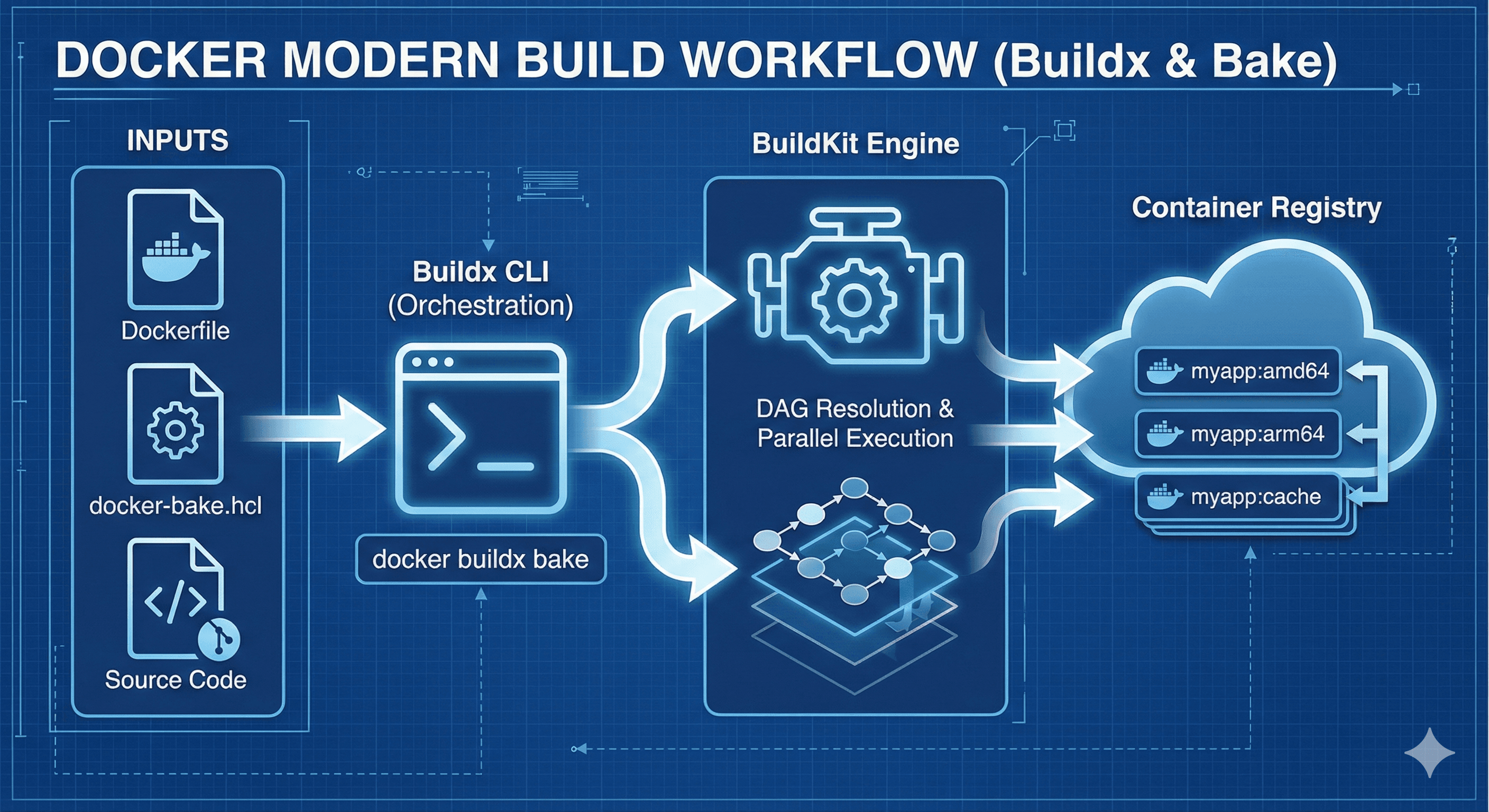
#🚨 The Problem: The Sequential Bottleneck
Traditional Docker builds were serial. The legacy builder processed your Dockerfile line-by-line, top-to-bottom. If you had a multi-stage build where the "frontend" and "backend" didn't depend on each other, you still had to wait for one to finish before the other started. Furthermore, every build required sending the entire "context" (all your files) to the Docker daemon, even if you only changed one line of code.
#🏗️ The Modern Stack: BuildKit with Buildx
Since Docker v23.0, the "Legacy Builder" is officially deprecated for Linux. We now use a two-part system:
- BuildKit (The Engine): The high-performance backend. It doesn't care about "Dockerfiles" directly; it works with LLB (Low-Level Build), a binary format that defines a dependency graph.
- Buildx (The Client): A CLI plugin that acts as the control center for BuildKit. It allows you to manage multiple "builders" (on your laptop, in Kubernetes, or in the Cloud) and unlocks advanced features like multi-platform support.
#🚀 Key Performance Feature: The DAG Solver
Unlike the old builder, BuildKit analyses your Dockerfile and creates a .
If you found this helpful, please like and share to support the content!
76 views
Share:
Comments (0)
Leave a comment
About MjShetty
Always curious to understand the concept, learning by breaking and fixing, and passionate about sharing knowledge with the community.Get in touch with me→