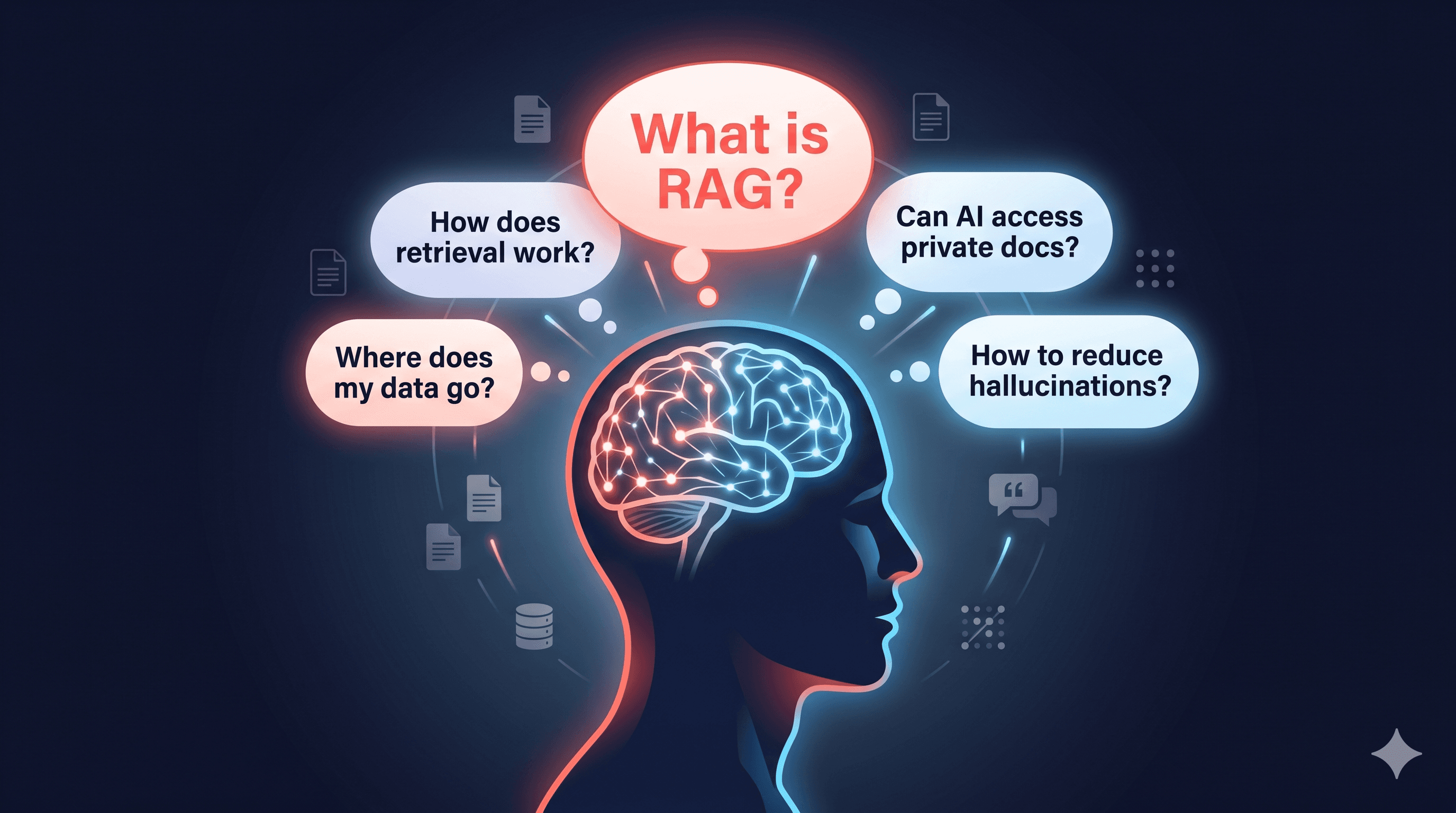
You have an LLM. It is smart, but it has never read your company's internal docs. Ask it about your work-from-home policy and it will either hallucinate an answer or politely refuse. RAG is the pattern that fixes this.
Think of a courtroom. The judge (the LLM) has broad legal knowledge from years of training, but has not memorised every private case file in your company's archive. RAG acts like a court clerk: when the judge needs to make a ruling, the clerk rapidly searches the private library, retrieves the exact relevant documents, and hands them over. The judge can now deliver a precise, evidence-backed ruling instead of guessing.
Large Language Models are trained on public data up to a fixed cut-off date. They have no access to your private documents, your internal wikis, or your latest policy updates. This creates three gaps:
Retrieval-Augmented Generation (RAG) closes all three.
Every RAG system runs the same fundamental cycle:
If you found this helpful, please like and share to support the content!
Always curious to understand the concept, learning by breaking and fixing, and passionate about sharing knowledge with the community.Get in touch with me→
Query → [ Retrieve ] → [ Augment ] → [ Generate ] → Answer
Gather your raw data PDFs, Google Docs, wikis, database exports. Split each document into smaller, overlapping chunks of a few paragraphs each. This is required because LLMs have a finite context window and cannot process an entire corporate library at once.
Pass each chunk through an embedding model. This converts human-readable text into high-dimensional numerical vectors that capture semantic meaning. The model understands mathematically that "raining cats and dogs" is related to weather, not pets.
Persist those vectors in a vector database alongside metadata — author, creation date, and access permissions. This is your AI-ready, access-controlled private library. Metadata ensures that sensitive documents remain restricted to authorized users.
When a user asks a question, the system embeds the query using the same model and performs a similarity search across all stored vectors. The closest matches are the most semantically relevant chunks.
Pro Tip: Production systems use Hybrid Search — combining vector-based semantic search with traditional keyword matching — to avoid missing exact-match terms. A Reranker then re-scores and reorders the candidates so the most relevant evidence lands at the top.
Package the retrieved chunks with the original question into a single prompt. You are essentially telling the LLM: "Here is the user's question, and here are 5 paragraphs from our internal handbook. Answer using ONLY these paragraphs."
The LLM reads the enriched prompt and produces a grounded response, complete with citations pointing back to the exact internal documents it drew from. This builds user trust and drastically reduces hallucinations.
Once the system is live, continuous monitoring is essential:
RAG is the most practical way to turn a general-purpose LLM into a domain expert that actually knows your business. You get the power of a large language model without the cost of retraining — while keeping your proprietary data secure, your answers accurate, and your users confident.
Three things to remember: